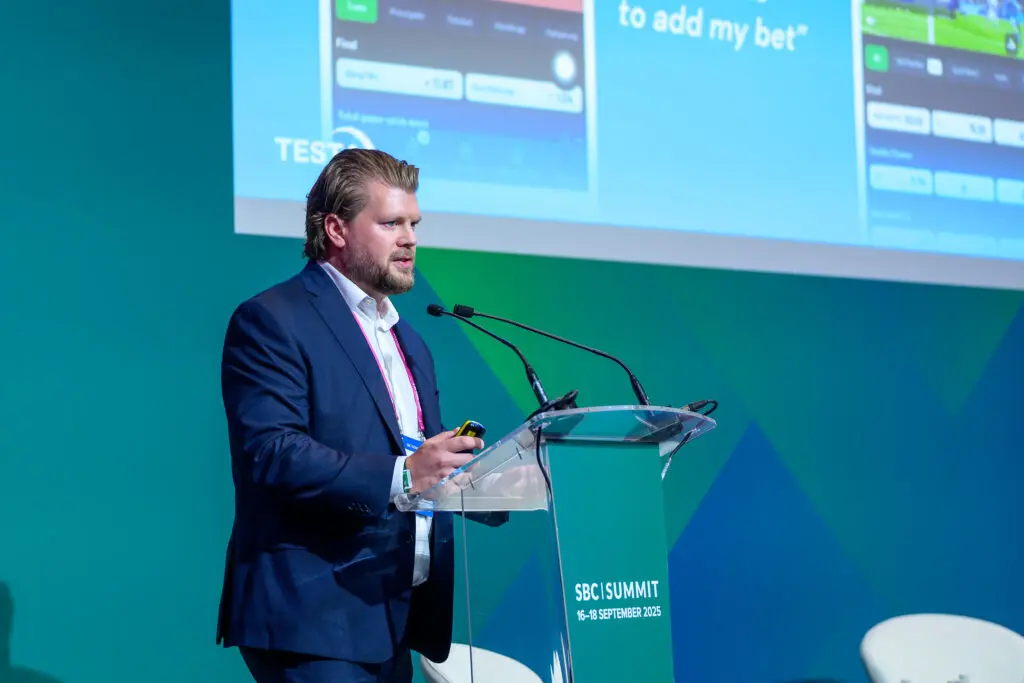
At this year’s SBC Summit Lisbon, TESTA CEO Kyle Wiltshire took the stage to present fresh field data on one of the fastest-evolving areas of sportsbook technology: watch & bet. Backed by TESTA’s crowdsourced testing network—spanning more than 800 cities and over 100 countries—Kyle walked operators and tech providers through what real users experienced when streaming, betting, and navigating live events across five major markets.
“We are a crowd testing company,” Kyle began. “If there’s online gambling, we’ve probably got somebody on the ground that can look at it.” That global reach formed the backbone of the study, which examined five leading operators—Bet365 (US), Betano (Brazil), Superbet (Poland), MaxBet (Romania), and Ladbrokes (UK)—through real accounts, real deposits, and real wagers.
TESTA recruited local testers in each market, asked them to create new accounts, and assigned structured questionnaires. Every stream was loaded 10 times to confirm reproducibility, and testers evaluated not only performance but also UX, features, and perceived ease of use.
The goal, Kyle explained, was to show operators and watch-and-bet providers “how it’s configured, how it looks out there, and what the real user actually experiences.”

What the team found: Consistency, variation, and a few surprises
Across all five operators, live streaming was available—but what happened inside the video window varied substantially.
Feature variation observed across operators:
- Live streaming: 5/5
- Live highlights: 4/5
- Add-to-betslip inside the stream: 3/5
- Interactive in-stream stats: 1/5
Standout UX from MaxBet (Romania)
MaxBet was the only operator offering fully interactive stats within the video. The tester praised the design, calling out useful catch-up highlights and real-time insights. As Kyle noted, “Quite a lot of information to pack into this little video screen, but it’s well done.”
Bet365 (US): A reproduction-worthy issue
The New Jersey tester reported AV sync issues during streaming—something TESTA encourages operators to validate through multi-tester reproduction. Still, testers praised Bet365’s intuitive highlights timeline. “Pretty much all of them came back and said, ‘This is pretty intuitive. I get it.’”
Betano, Ladbrokes, and Superbet
- Ladbrokes (UK): Smooth landscape-first experience with rapid loading and no AV issues.
- Betano (Brazil): Strong load times and a clean bet-adding interface, though less transparent than others.
- Superbet (Poland): Good stream quality but some UI elements were cut off on the tester’s device, highlighting the importance of device-specific QA.
Why this matters: Device diversity, network variability, and real-world conditions
The biggest takeaway wasn’t about a single operator—it was about the diversity of user environments.
Kyle emphasized that “the average phone in the US might be $600–700, while in Brazil or Asia it may be $100–150.” Pair that with variable ISPs, inconsistent 5G availability, and different streaming protocols, and the importance of field testing becomes obvious.
Compression technologies, device heating, CPU load, and network congestion all affect live betting experiences differently across markets. Without real-world tests, these issues often go unseen until customers complain—or churn.
Conclusion: Why watch & bet demands real-world testing
Kyle closed with a clear message: watch & bet is customizable, complex, and deeply dependent on local context.
“Each market has their own preferences and devices,” he said. “If you wish to get into the space, make sure you understand what your competitors are doing, how you stack up, because that’s going to make the big difference.”
For sportsbook operators and watch-and-bet technology providers, the value of crowdsourced testing is simple: real people, real devices, real conditions—and real clarity on how your product performs where it actually matters.
