Featuring TESTA founder and CEO, Kyle Wiltshire
This panel discussion at the Next Summit Valletta delivered expert analysis of the global gaming industry, encompassing online and select land-based gambling markets. Moderated by Adam Rosenberg, the panel featured George Merodoulakis (Campeon Gaming), Kyle Wiltshire (TESTA), Nadiya Attard (Elantil Gaming), Thomas Kusztos (Playson), and Dinos Stranomitis (Altenar).
Organized around four overlays—geographic, operational, regulatory, and strategic—the conversation explored which regions, companies, and strategies are succeeding or faltering in a competitive, rapidly evolving landscape. The discussion highlighted the pivotal role of localization, the tension between innovation and regulation, and the impact of market-specific strategies, identifying clear winners and losers.
Geography: Latin America surges, Europe falters
The panel identified Latin America as a major winner, driven by its young, tech-savvy populations and emerging opportunities. Dinos described the region as “a medieval Europe that everyone is getting a boat going down the sea and going to find the El Dorado” (58:18–58:23), capturing the rush of operators to markets like Brazil, where new regulations are opening doors. However, he cautioned that sustainable growth requires proper regulation to avoid a market dominated by “pirates.”
In contrast, Europe is losing ground due to conservative policies and restrictive regulations. Dinos noted, “Europe is becoming a little bit more conservative and… our industry is losing in Europe” (58:04–58:12), with countries like Germany, the UK, France, and Italy burdened by complex compliance requirements. Germany was repeatedly flagged as a loser, with Dinos stating, “Germany is an easy one” (1:23:34), due to its limited casino offerings and regulatory barriers. North America struggles with regulatory hurdles, while the Far East is detached due to geopolitical issues. Africa shows potential but remains underdeveloped with small-scale impact.
Kyle Wiltshire offered a framework for analyzing markets, categorizing them by regulation status (regulated, unregulated, or black), income levels, and demographics (e.g., young vs. aging populations, mobile vs. desktop usage). He explained, “you’ve got markets where the population is older… if there’s a gaming market to be had, it’s already been cracked and now it’s declining” (1:01:41–1:01:55). For Brazil, he questioned, “is there actually something in the company’s DNA that’s going to make it compete and be better than the market leaders there?” (1:02:25–1:02:38), urging operators to assess their competitive edge before entering newly regulated markets.
Operations: Localization is key
Operationally, the panel emphasized that localization, personalization, and customization are essential for success. George highlighted these as critical drivers, stating, “personalization, localization, customization” (1:09:25–1:09:31) enable operators to meet diverse player needs and maintain relevance. Local infrastructure, such as server locations and payment solutions, is vital for seamless experiences. Dinos pointed out significant differences even between neighboring countries, noting, “there is a difference in consumer behavior between Peru and Colombia… it’s completely different profiles” (1:14:42–1:14:47). Thomas stressed the need for instant engagement, as “the attention span of the player is very very short” (1:03:58–1:04:03), requiring fast-loading games and tailored promotional tools.
Nadiya added that entering markets like Portugal is challenging due to complex requirements, while Dinos emphasized the need for localized payment solutions, stating, “you have two neighboring countries and one is using one and the other one is using completely different” (1:15:55–1:16:01). Failure to adapt can lead to significant revenue losses. Kyle Wiltshire reinforced the importance of on-the-ground insights, sharing an example from Japan where a baccarat table mistranslated “banker” as a financial term rather than the casino term “banka”: “there was this thing on the Baccarat table that said player and banker… they used a translation house and banker literally said the banker that you would see at your bank” (1:11:20–1:11:32). He stressed, “just being on the ground or having feedback from the ground is very important” (1:11:08–1:11:15), as such errors can make platforms feel “cheap” to players (1:12:14–1:12:21), underscoring the need to “nail each location” (1:12:28–1:12:35)

Regulation: Players and governments lose
The regulatory landscape revealed a stark divide between regulated and gray/black markets. Regulated market leaders, particularly large, publicly listed companies, are winning by prioritizing compliance. Nadiya observed, “the big tier ones, the public listed companies, the serious guys, they’re mostly focusing on regulated markets” (1:19:02–1:19:07), using gray market revenues to fuel growth in regulated environments. However, restrictive regulations in Europe are creating losers. European players face diminished experiences, with Dinos asserting, “the player is losing at the end… the European player, UK player, German players” (1:23:46–1:23:52), as affordability checks and slow spin times push them toward unregulated markets.
European governments are also losing by failing to optimize tax revenues. George argued, “the local governments are the losers because… they don’t make the money they could” (1:24:04–1:24:29), as overly stringent rules drive operators and players to gray markets. Germany, the UK, and Portugal were criticized for inconsistent or excessive regulations, with Nadia noting, “every country in Europe has different gaming requirements… the more markets are opening, the more complex it becomes” (1:06:21–1:06:33). Thomas highlighted the frustration of adapting to “a huge number of regulations which every six months there’s a new rule” (1:24:59–1:25:04). Kyle Wiltshire addressed regulation’s impact on market entry, noting that newly regulated markets like Brazil attract a rush of operators, but success requires preparation: “when a market is going regulated, then everybody gate crashes… but you sometimes forget what is this, an old market, is it a young market, do we actually have a competitive advantage here?” (1:02:06–1:02:19).

Strategy: Disruptors and risk-takers prevail
Strategically, disruptive operators and tech providers are winning by leveraging alternative marketing channels (e.g., influencers, affiliate networks), crypto casinos, and prediction markets. George noted, “the regulation is getting tight, people are getting tired with regulation, they’re moving to gray markets” (1:26:36–1:26:41), where these strategies flourish. Tech companies addressing niche challenges, such as payment solutions or user experience optimization, were also identified as winners. Thomas stated, “people who come up with solving an actual problem of one of the players in the food chain… that can be a big winner” (1:27:15–1:27:27). Dinos emphasized calculated risk-taking, advising, “don’t go too hard against the rules, but you need to have a tech which supports it” (1:26:03–1:26:10), as “the ones who will get the risk will win” (1:25:47–1:25:53).
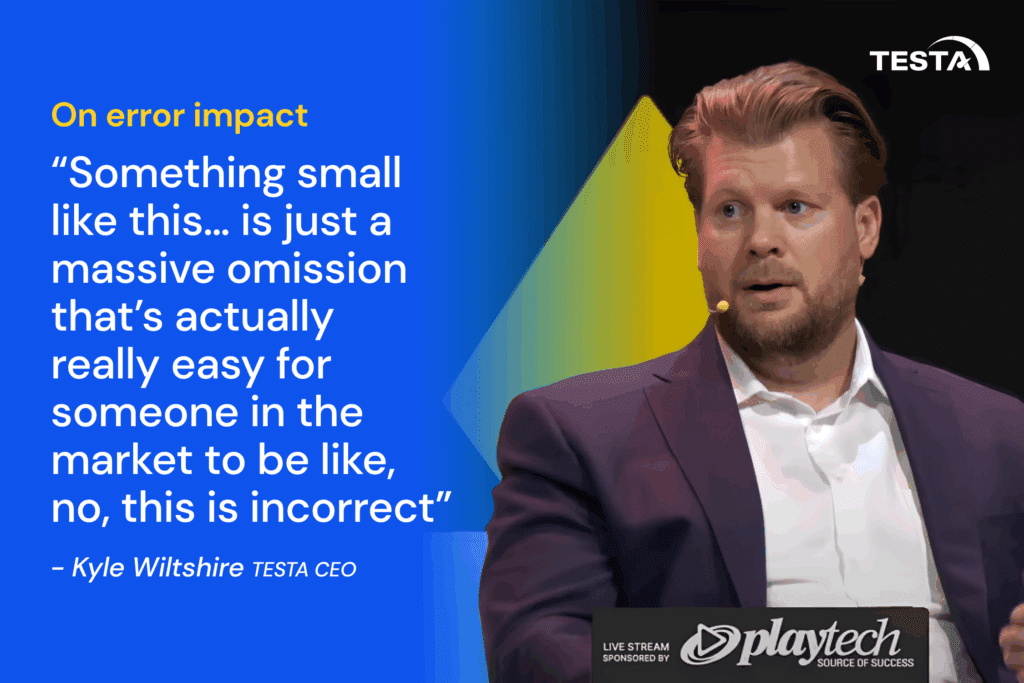
Kyle Wiltshire’s earlier comments on preventing errors through localized testing align with this strategic focus. He noted, “something small like this… is just a massive omission that’s actually really easy for someone in the market to be like, no, this is incorrect” (1:11:48–1:12:01), highlighting how on-the-ground data helps operators avoid missteps and stay competitive. His approach to “get data from within the market” (1:11:03–1:11:08) supports the panel’s call for innovative, market-specific strategies.
Key dynamics and conclusion
The panel concluded that winners—Latin America, regulated market leaders, and disruptive operators/tech providers—thrive through localization, risk-taking, and adaptability to regulatory shifts. Losers—European players, governments, and over-regulated jurisdictions like Germany—struggle with restrictive policies that degrade experiences and reduce revenues. The discussion underscored the importance of tailoring strategies to local markets, with panelists like Kyle Wiltshire emphasizing practical tools like on-the-ground testing to ensure cultural and technical alignment. As Wiltshire put it, “you really need to localize and nail each location” (1:12:28–1:12:35), a sentiment echoed across the panel. Success in global markets hinges on balancing innovation with compliance, with those who adapt swiftly and leverage local expertise poised to lead.
