Overview
A major iGaming operator planned a payment-method rollout across several markets and needed to know whether the plan held up once real players in those countries tried to register, deposit, and withdraw.
Problem
A payment rollout is usually validated against an internal plan: methods enabled, currencies configured, and countries switched on. That plan shows what should work. It does not show what a player sees when the registration page loads on a local connection, or whether a listed method can actually be selected and completed. Central QA could confirm the configuration, but not the real experience in each market.
Solution
TESTA built a structured, two-phase payment testing programme with local testers.
1. Structured payment scenarios
Testers followed defined payment-method scenarios across multiple currencies. Separate test groups and username whitelisting kept accounts controlled and traceable.
2. End-to-end money journeys
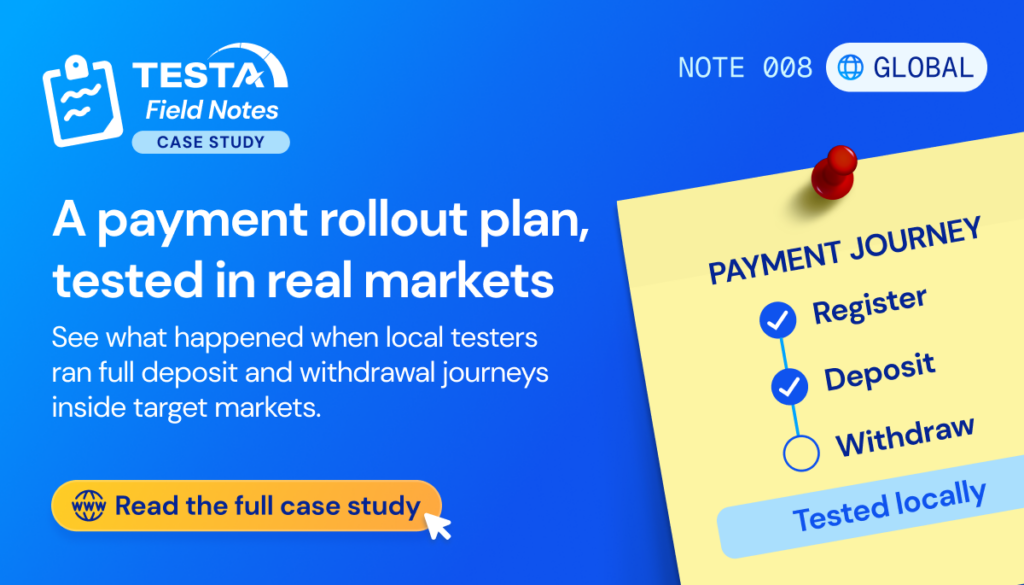
Each tester completed registration, deposit, and withdrawal, capturing minimum and maximum limits, transaction timing, and every step with screenshots and video.
3. Real local conditions, no VPN
Testing ran on domestic connections and local hardware in each target country. VPNs were avoided because they can hide the country-specific behaviour that determines whether a payment completes.
4. Competitor payment benchmarking
A second phase repeated the same journeys on competitor platforms under matched conditions, comparing deposit and withdrawal flows, method availability, limits, and timing.
Outcome
Testing surfaced country-specific constraints that a central plan would miss:
- Germany was not listed as a selectable country during registration
- India registration pages failed or redirected before a deposit could start
- Several countries were restricted outright, including the US, UK, and France
- Skrill was not usable in Japan
- South Korean banks declined wallets linked to gambling
- UPI behaviour in India and other local methods varied by market and required direct observation
Business impact
The operator gained market-specific evidence, enabling the payments and product teams to:
- See which methods are visible and selectable in each country
- Identify where registration breaks before a deposit can start
- Confirm which currencies and countries are viable for launch
- Compare deposit and withdrawal performance with direct competitors
Conclusion
A rollout plan sets the intention. Real-market testing shows what a player in each country can actually do with their money. Running the journey with local testers, under local conditions, gave a major operator the evidence to launch payment methods where they work and fix them where they do not.

Planning a payment-method rollout across new markets? Get in touch to validate it with local testers before players run into problems.
